
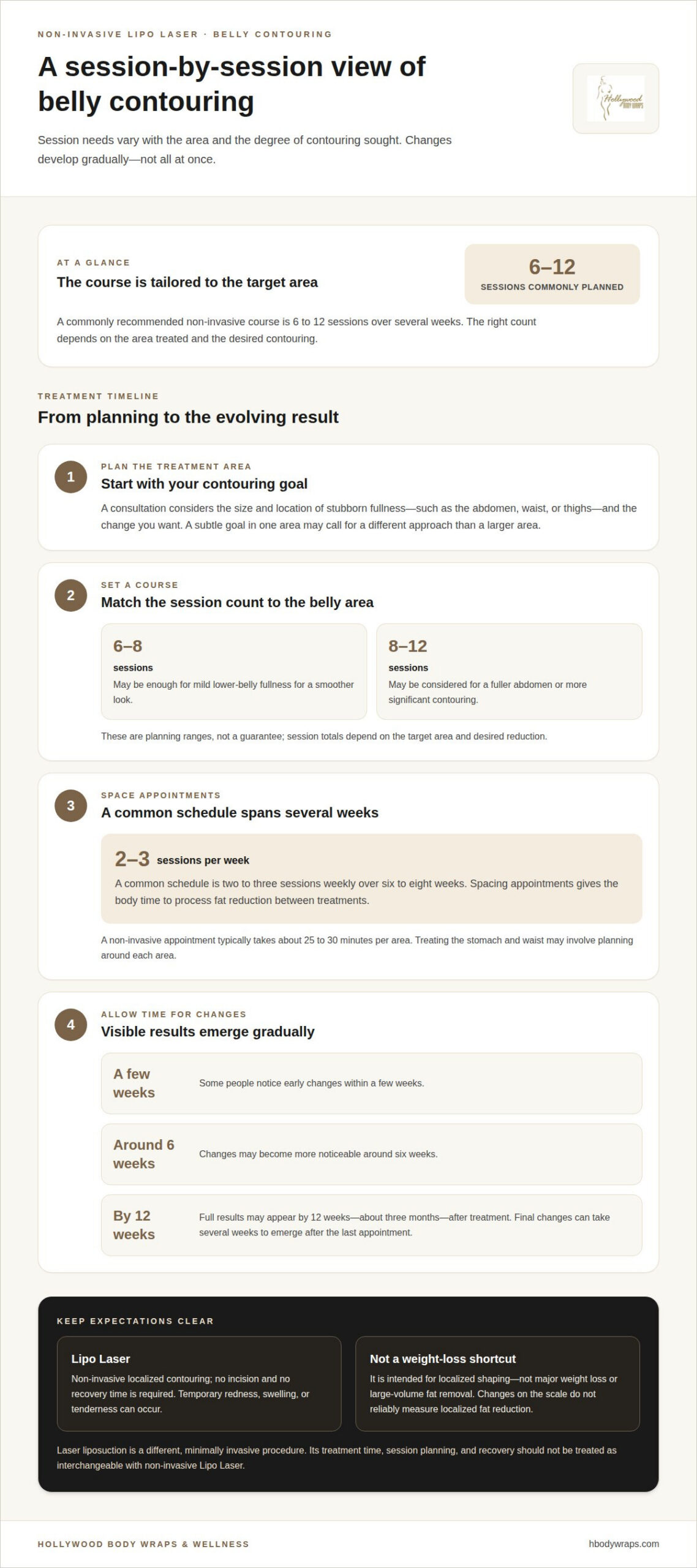
Lipo laser is a body-contouring treatment, not a weight-loss shortcut. For mild lower-belly fullness, 6 to 8 sessions may be enough for a smoother look; a fuller midsection may call for 8 to 12. So, how many lipo laser sessions are needed for belly fat depends on the area being treated and the degree of contouring sought.
If stubborn abdominal fullness remains despite your efforts, it’s understandable to want a clear plan and realistic timeline. Lipo Laser uses low-level laser technology to target fat beneath the skin, and changes develop gradually rather than appearing all at once.
Here, you’ll learn what non-invasive Lipo Laser involves, how long a session may take, and when changes could become visible. You’ll also see how to distinguish localized contouring from broader weight-loss goals, so you can assess whether this treatment fits what you want to achieve.
Key Takeaways
- A non-invasive lipo laser appointment typically takes about 25 to 30 minutes per area, making it useful to understand how treatment time fits into your routine.
- The number of sessions can vary with the size of the area and your contouring goals, so the treatment plan should reflect your starting point.
- Changes may become noticeable gradually; learn what timing to expect and why the final appearance can take longer to emerge.
- Lipo laser is designed for localized contouring, not major weight loss. Clarifying your goal can help you decide whether it aligns with what the treatment can address.
Treatment duration
Non-invasive laser lipolysis sessions are generally brief, though duration can vary by treatment area. For example, treating the stomach and waist may involve planning around each area rather than assuming one appointment covers every contour. The procedure uses low-level laser technology and doesn’t involve an incision. It differs from minimally invasive laser lipolysis, which takes one to two hours, depending on the area treated.
A consultation helps shape a plan around your goals. The practitioner considers the size and location of stubborn fullness and whether you want to address your abdomen, waist, or thighs. A goal focused on subtle contouring in one area may call for a different approach than contouring a larger area. Lipo Laser is for shaping, not changing overall weight.
Is Lipo Laser FDA-cleared or FDA-approved for fat reduction? FDA clearance or approval applies to a specific device and its intended use. The name “Lipo Laser” alone does not establish either status for a particular device or its use for fat reduction.
How often should Lipo Laser sessions be scheduled? A common schedule is two to three sessions a week over six to eight weeks. Spacing appointments over several weeks gives the body time to process fat reduction between treatments.
Who is a good candidate for Lipo Laser, and what are its limitations? Some candidacy criteria use a BMI under 30, but the treatment is intended for localized contouring, not major weight loss or large-volume fat removal. The amount and location of stubborn fullness, plus your desired change, affect whether the goal fits this approach.
What should you do before and after a Lipo Laser session? A practical preparation step is to discuss your goals and treatment area during planning. Afterward, drink plenty of water and consider light activity, such as walking. Non-invasive treatment requires no recovery time, though temporary redness, swelling, or tenderness can occur.
These distinctions help set realistic expectations before scheduling. Separate non-invasive Lipo Laser from laser liposuction, which is a minimally invasive procedure. Lipo Laser does not involve surgery or an incision; the procedure, treatment time, and recovery differ. Your target area and contouring goal are central to planning.
How Many Laser Lipo Treatments Are Needed?
Session counts depend on the treatment type, body area, and desired contouring. Separate non-invasive treatment courses from laser liposuction counts.
Lipo Laser, CoolSculpting, ultrasound cavitation, and liposuction are different approaches, so their session counts aren’t interchangeable. Non-invasive laser lipo is commonly planned as a series; laser liposuction generally involves one treatment per area.
Typical Treatment Counts by Body Part
Some guidance describes one to two laser lipolysis treatments per body part, while non-invasive plans often involve more sessions. The distinction matters: a treatment count for one area isn’t necessarily the full course. For mild lower-belly fullness, 6 to 8 sessions may create a smoother look; a fuller abdomen may call for 8 to 12.
Sessions for Visible Results
Visible change is associated with completing a course, not simply counting one appointment. Six to eight sessions are commonly recommended for results, while some plans extend to 12 for more significant reduction. Your target area and contouring goal help explain why session totals vary, even when two people focus on the abdomen.
Laser Liposuction Session Counts
Treatment schedules can differ between laser liposuction and non-invasive approaches. This is a different procedure, not an alternative label for non-invasive Lipo Laser. The distinction matters when comparing expected appointments, recovery, and fat removal. Plastic surgery approaches shouldn’t be counted as though they use the same treatment schedule.
Recommended Session Counts
For non-invasive laser lipo, 6 to 12 sessions over several weeks is a commonly recommended range. Six sessions are often cited for visible, lasting results; up to 12 may suit more significant contouring goals. A healthy lifestyle supports maintaining changes, but the session count itself depends on the area and desired reduction.
For a plan centered on non-invasive treatment, explore non-invasive Lipo Laser treatment as a body-contouring option.
When results may become visible
Changes after non-invasive laser lipolysis develop gradually, not immediately after an abdomen session. Some people notice early changes within a few weeks, with results becoming more noticeable around six weeks. The body’s lymphatic system naturally clears released fat over the following days, so the visible contour can evolve after treatment. That gradual process is why the mirror may not show the full change right away.
Full results may appear by 12 weeks, or about three months, after treatment. The timing can depend on the treated area, the amount of localized fullness, and the number of sessions in the plan. Final changes can also take several weeks to emerge after the last appointment. For example, a person treating the abdomen should assess the overall contour over time, rather than judging the outcome immediately after one session.
Lipo laser is body contouring, not a weight-loss method. Changes on the scale don’t measure localized fat reduction reliably; weight, fat distribution, and the treatment goal all shape what someone notices. Maintaining a healthy lifestyle after treatment supports preserving results and helps limit new fat accumulation. Regular activity, such as walking, and drinking plenty of water are practical habits that support the body’s ongoing processes.
Non-invasive laser lipolysis requires no recovery time, while minimally invasive laser lipolysis can involve a few days of recovery. These are distinct procedures, not interchangeable descriptions of traditional liposuction. Invasive treatment can involve different medical considerations, including anesthesia and recovery, so surgical results follow a different timeline. Skin tightening after laser-assisted liposuction may continue for 3-6 months, but that timing shouldn’t be applied automatically to non-invasive treatment. Keep the treatment type and goal clear when interpreting changes.
Laser lipo as body contouring rather than weight loss
Lipo Laser is intended to contour specific areas, not produce major weight loss. It uses low-level laser technology to target fat beneath the skin. For example, someone near their goal weight who still has abdominal fullness may be considering a localized contouring approach. That is different from seeking broad fat removal or a lower number on the scale.
A potential candidate is typically close to their ideal body weight, sometimes within 10-20 pounds. The treatment may suit someone seeking a modest change in a defined area, rather than large-volume reduction. For example, a waistline contouring goal differs from a plan focused on losing weight across the whole body. Exercise and healthy habits remain relevant to weight management; laser lipolysis isn’t a substitute for them.
Set expectations around shape, not pounds. The scale measures total body weight, while a contouring goal concerns the treated area’s appearance. Non-invasive treatment also differs from surgical fat removal: it isn’t traditional liposuction, and it doesn’t involve the same procedure. Non-invasive laser lipolysis requires no recovery time, although temporary redness, swelling, or tenderness can occur.
Skin tightening is another distinct outcome to consider. Laser-assisted liposuction may involve skin tightening over 3-6 months, but that surgical-treatment timeline shouldn’t be assumed for non-invasive laser lipolysis. The useful question is whether your priority is a localized contour change, overall weight reduction, or skin firmness. Each describes a different goal, and the treatment approach should match it.
For a focused goal such as stubborn abdominal fullness, define the area and desired contour before planning treatment. If your primary aim is significant weight loss, laser lipolysis isn’t designed for that purpose. Explore body-contouring options to consider an approach aligned with a localized shaping goal.
Hollywood Body Wraps & Wellness: Non invasive- Lipo Laser
Hollywood Body Wraps & Wellness offers non-invasive Lipo Laser for people seeking to contour localized fullness, including around the abdomen. It may suit a goal focused on shaping a specific area rather than pursuing major weight loss. The plan should reflect the area you want to address and the change you hope to see.
Understanding the difference between contouring and weight loss can help you decide whether Lipo Laser aligns with your goal. Hollywood Body Wraps & Wellness serves clients in Tampa, Carrollwood, Lutz, Wesley Chapel, and Westchase. To discuss targeted body shaping, schedule an appointment with the spa.
Choose a Next Step That Fits Your Goals
Your next step is to clarify what you want to change and what success would look like. How many Lipo Laser sessions are needed for belly fat depends on your target area, contouring goals, and treatment plan. A focused conversation helps determine whether non-invasive treatment suits your goal, without treating body contouring as a substitute for weight loss.
Hollywood Body Wraps & Wellness also offers Mineral inch loss Body Wraps, a non-invasive facial lift, and Facials for different wellness and beauty goals. Each service addresses a different concern, so choose based on the result you’re seeking. To discuss non-invasive Lipo Laser and your body-contouring goals, contact Hollywood Body Wraps & Wellness. Take the next step at your own pace and with a clear sense of what matters to you.
Frequently Asked Questions
What is laser lipolysis?
Laser lipolysis uses low-level laser technology to target fat cells beneath the skin. It’s a non-invasive approach, distinct from surgical liposuction, which removes fat through a procedure. For example, someone focused on localized fullness around the abdomen may consider contouring rather than broad weight reduction. The intended outcome is a change in the treated area, not a substitute for overall weight management.
How Many Sessions Are Needed to See Results?
Visible results are commonly associated with a course of 6 to 8 sessions, while some treatment plans extend to 12. For belly contouring, the amount of fullness and the size of the treatment area help shape the plan. If you’re asking how many lipo laser sessions are needed for belly fat, distinguish mild lower-belly fullness from a fuller midsection when setting expectations.
What Is Treatment Like?
A non-invasive session generally takes about 25 to 30 minutes per area. The treatment uses low-level laser technology on the selected area, such as the abdomen. No recovery time is required, though temporary redness, swelling, or tenderness can occur. A useful planning detail is whether your goal involves one area or several, since each treatment area affects appointment time.
Will You Be Able to Gain Weight After Laser Lipo?
Yes. Laser lipo doesn’t prevent future weight gain or new fat accumulation. It focuses on contouring a selected area, so changes in overall weight can affect how your shape looks afterward. Maintaining a healthy lifestyle supports preserving results. For example, keep your long-term goal focused on steady weight management, rather than expecting a contouring treatment to manage weight for you.
Can laser lipo damage organs?
Non-invasive laser lipolysis targets fat cells beneath the skin using low-level laser technology, without damaging surrounding tissues. It doesn’t use an incision to reach internal organs. This answer applies to non-invasive treatment, not minimally invasive laser procedures or surgical liposuction, which are different approaches. Temporary redness, swelling, or tenderness can still occur after a non-invasive session.
How Many Inches Can You Lose Around the Waist?
There isn’t a single waist-measurement change that applies to everyone. The outcome depends on the treated area, starting contour, and individual response, so a promised figure would be misleading. To track progress, measure at the same waist location and use the same method each time. Also consider how clothing fits and how your outline looks, not just the tape measurement.