Peptide therapy for anti-aging in Lutz isn’t an overnight approach: it may take a few weeks to begin working, and the full effect may take 3 to 6 months to become apparent. Results vary, so the timeline depends on the peptide and treatment plan. That slower pace matters when you’re comparing it with wellness treatments focused on visible or immediate changes.
If muscle loss, low energy, or changes in how your body feels have you looking for support, it’s natural to want to understand the process before deciding. Peptide therapy may be delivered in different ways, and the approach should reflect the intended goal rather than rely on a one-size-fits-all promise.
Here’s what to consider: how delivery methods and protocols differ, what support for muscle loss and low energy may mean, and how peptide therapy compares with other wellness options. You’ll also learn what to consider about safety and timing, so you can weigh the approach and make an informed next step.
Key Takeaways
- Learn what a personalized peptide protocol considers, from your goals and health history to the intended treatment approach.
- Understand how muscle changes and low energy may shape the conversation, and what safety considerations deserve attention.
- Compare injection, topical, and oral delivery options, including why the route can affect how a peptide is absorbed.
- See how peptide therapy differs from wellness treatments focused on external appearance, so you can match an option to your goal.
What Can You Expect From Peptide Therapy?
An assessment should come before a protocol. The peptide, intended goal, health history, and current medicines all matter. A focused plan takes individual differences into account instead of treating every concern alike.
Medication and Supplement Interactions
Bring a complete list of prescriptions, over-the-counter medicines, and supplements to the assessment. Include doses and how often you use each one; this helps the prescriber review possible interactions and side effects. For example, a peptide discussed for hormone signaling calls for a different review than one considered for skin repair or healing. Tell the prescriber about changes in immune health or inflammation, too. In Florida, prescription and compounding rules depend on the specific product and intended use, not one rule for every peptide. Ask whether the proposed preparation is prescribed or compounded, and what that means for your treatment.
Physician Supervision and Advice
Medical supervision helps connect the proposed peptide with your goals, health history, and relevant risks. Before starting, ask the prescriber to explain the product, route, planned dose, monitoring, and which side effects to report. To check a Lutz provider’s credentials, get the treating clinician’s full name and Florida license number, then look up the license through Florida’s official health-professional licensing system. Ask who will review your response and handle concerns during treatment.
Personalization starts with a clear goal. Skin texture, energy, muscle changes, and immune support are different concerns, so they shouldn’t automatically lead to the same peptide. GHK-Cu is discussed in relation to skin repair and healing; CJC-1295 relates to growth hormone release, while Thymosin Alpha-1 is associated with immune modulation. These examples describe different areas of interest, not a recommendation or interchangeable options.
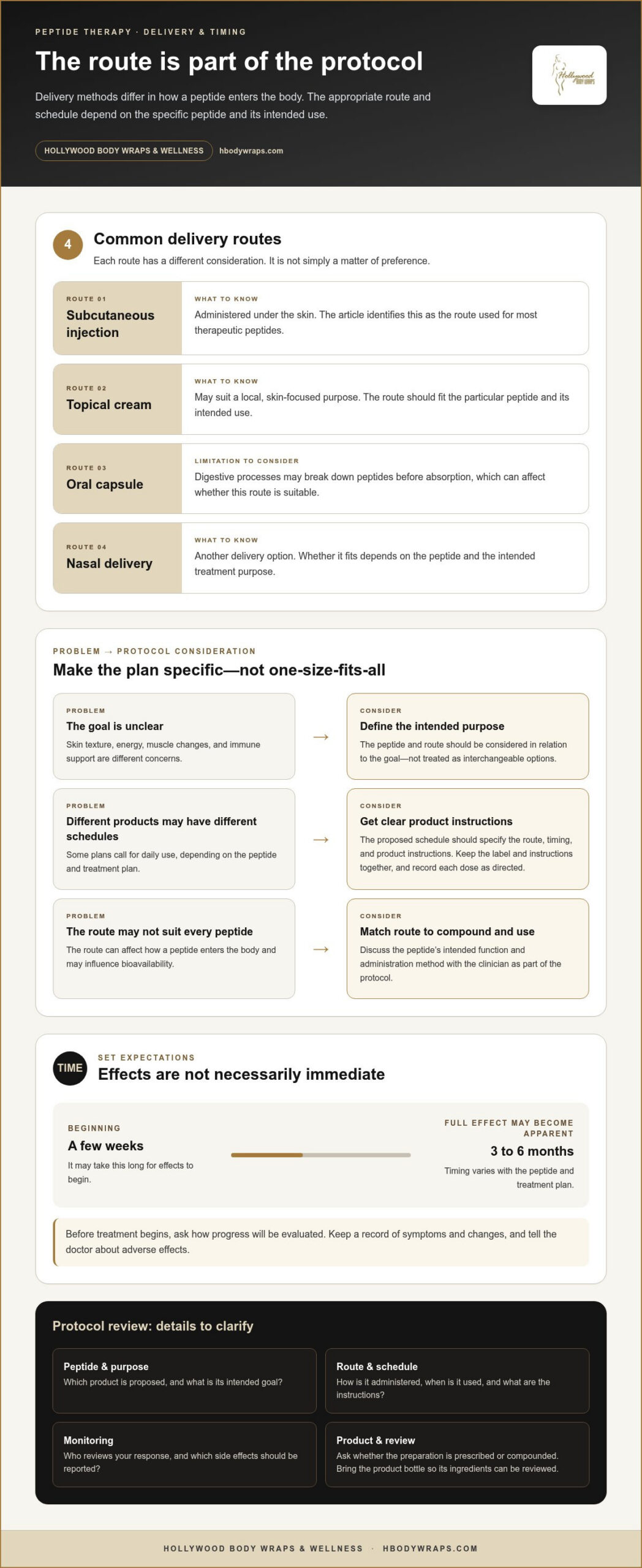
Ask how progress will be evaluated before treatment begins. A few weeks may pass before effects begin, and the full effect may take 3 to 6 months to become apparent. Keep a record of symptoms and changes, and tell your doctor about adverse effects. Bring the product bottle so its ingredients can be reviewed. That practical step helps keep the biological goal, product, and supervision aligned.
Potential support for age-related muscle loss and low energy
Age-related muscle changes can affect strength, daily function, and recovery. Peptides are short chains of amino acids, and some influence biological signals such as hormone release. This helps explain interest in muscle preservation and energy, but it doesn’t establish that a peptide will restore strength or prevent age-related decline. Sleep, nutrition, activity, health conditions, and weight-loss goals also shape how someone feels and functions.
There is no blanket FDA approval for peptide therapy as an anti-aging or longevity treatment. More than 30 peptides have been approved for medical use, but approval applies to specific medicines and uses. BPC-157, TB-500, and MOTS-c are not FDA-approved for the broad uses described. These distinctions matter when a product is marketed for wellness, repair, or longevity.
Which peptides are marketed for anti-aging? GHK-Cu is promoted for skin support, while Epithalon is discussed in connection with cellular longevity. CJC-1295 is associated with growth hormone release, a different proposed pathway. Marketing claims don’t make these peptides interchangeable or establish improved sleep, energy, muscle, or skin. Match the claimed purpose to the evidence and the specific product.
Safety deserves as much attention as potential benefits. Peptide therapy may be associated with injection-site reactions or hormonal imbalances. Researchers are also concerned that stimulating cell regeneration could promote tumor growth. Personal health history and the peptide’s intended action are important parts of any risk discussion. Report adverse effects to a healthcare provider, and use products from reputable manufacturers.
For muscle and energy goals, define what you want to improve before considering a protocol. Track practical markers, such as strength during usual activities, sleep quality, and daily energy, rather than relying on a broad “anti-aging” promise. Peptides are not a substitute for addressing the causes of fatigue or muscle loss. For a distinct body-composition focus, explore peptide therapy options as part of your wellness planning.
Peptide delivery methods and treatment protocols
Peptide treatment plans vary by compound, intended function, and delivery route. A clinician considers whether the goal involves tissue support, metabolism, or other biological processes before discussing administration. The route affects how the peptide enters the body and may influence its bioavailability. The method is part of the protocol, not simply a matter of preference.
Common methods include subcutaneous injections, capsules, topical creams, and nasal delivery. Most therapeutic peptides are administered by subcutaneous injection, under the skin. Topical application may suit a local skin-focused purpose, while nasal delivery is another option. Oral capsules have a limitation: digestive processes may break down peptides before absorption. The route must suit the specific peptide and its intended use.
Protocols also vary in timing. Depending on the peptide and treatment plan, some call for daily use. The proposed schedule should clearly state the route, timing, and product instructions. Don’t assume that two products with similar wellness claims follow the same schedule. A treatment intended to affect weight or metabolism, for example, may involve different considerations from one aimed at tissue support. Keep the product label and instructions together, and record each dose as directed.
Compounded products need particular care. The U.S. Food and Drug Administration says compounded drugs containing AOD-9604 may pose significant immunogenicity risks for certain routes of administration and may have peptide-related impurity and API-characterization complexities. This makes the compound and administration route important details, not fine print. Ask what peptide the product contains, whether it is compounded, and which route the protocol specifies. Bring the container to medical appointments so the ingredients can be reviewed. Never switch from injection to capsule or topical use based only on a similar name or wellness claim. That can change absorption, exposure, and the treatment’s intended balance.
Peptide therapy compared with other wellness treatments
Peptide therapy and spa-based wellness treatments address different goals. Peptides are signaling molecules considered for specific biological pathways. CJC-1295, for example, is a growth hormone-releasing hormone analog. That mechanism differs from treatments chosen for visible skin or body concerns. Patients can compare options by identifying their desired effects first. Is the priority a biological process, skin appearance, or a localized body concern? That distinction makes a consultation more useful.
For skin-focused goals, GHK-Cu is associated with wound healing and skin regeneration. It can stimulate collagen production and support skin elasticity. A facial or non-invasive facial lift, by contrast, is selected for facial appearance rather than hormone signaling. Red light therapy is another distinct wellness option. These approaches aren’t interchangeable: match the treatment to the concern, and don’t assume claims about one method apply to another.
Body-focused treatments also differ from peptide protocols. Non-invasive cellulite treatment and vacuum therapy focus on a body-area concern, while peptide use depends on the compound and its intended biological action. Neither category should be treated as a substitute for the other. A personalized plan starts by defining the goal, such as skin texture, the appearance of cellulite, or a medical concern, then considering the treatment type that addresses it.
Use three questions to compare options: What concern is being addressed? Is the approach focused on a biological pathway or visible appearance? What outcomes will be used to assess progress? These questions help separate wellness goals from medical aims. If your priority is a non-invasive approach to a body or skin concern, explore wellness treatment options and consider how they align with your goals. Peptide therapy is a separate consideration, especially when a proposed effect involves hormones or other medical processes.
Hollywood Body Wraps & Wellness: Mineral inch loss Body Wraps
Hollywood Body Wraps & Wellness offers Mineral inch loss Body Wraps for body-contouring goals, not peptide-related concerns. If your priority is visible appearance, a body wrap may be a more relevant wellness option to explore than a treatment aimed at biological pathways.
For other aesthetic goals, the spa offers facials, a non-invasive facial lift, and non-invasive cellulite treatment. Each service addresses a different concern, so choose according to whether you’re focused on facial care, cellulite, or inch-loss goals. These services aren’t substitutes for medical assessment or treatment of low energy, muscle loss, or other health concerns.
To explore a body wrap or another aesthetic service, book an appointment with Hollywood Body Wraps & Wellness in Tampa, serving clients from Lutz and nearby communities.
Choose a Next Step That Fits Your Goals
Start by separating medical goals from aesthetic ones. If you’re exploring peptide therapy for anti-aging in Lutz, discuss the intended use, product, and oversight with a qualified healthcare provider. For appearance-focused care, decide which area you’d like to address and choose a service that matches that goal.
Hollywood Body Wraps & Wellness offers Mineral inch loss Body Wraps, Facials, and a Non invasive facial lift. These options support aesthetic goals, not medical assessment or treatment. Start by identifying what you want to focus on, then choose the option that aligns with it.
Take a thoughtful, comfortable next step. Contact Hollywood Body Wraps & Wellness to explore its aesthetic services and decide what feels right for your goals.
Frequently Asked Questions
Are peptides safe?
Peptide safety depends on the specific compound, product quality, route, and a person’s health history. “Peptides” describes a broad group, not one treatment with shared risks. The FDA Category 2 list includes 19 peptide compounds it deems unsafe to be made by federally regulated labs. Discuss the exact product with a qualified healthcare provider, especially if it’s compounded or promoted for broad wellness benefits.
Are there any side effects I should know about?
Possible side effects include injection-site reactions and hormonal imbalances. The type and likelihood may depend on the compound and how it’s administered. Keep the product packaging and a record of when symptoms occur, then report adverse effects to a healthcare provider. If you take several medicines or supplements, include them in the discussion so the clinician can assess your full regimen.
Do experts recommend peptides?
There isn’t a single expert recommendation that applies to every peptide or anti-aging goal. For peptide therapy for anti-aging in Lutz, a qualified healthcare provider can assess the specific compound, intended use, and your circumstances. More than 30 peptides have been approved for medical use, but that doesn’t mean every peptide is approved for longevity claims. Focus on the exact compound, not a general wellness label.
How are peptides administered?
Depending on the compound and intended use, peptides may be administered by injection, capsule, topical cream, or nasal delivery. These routes aren’t automatically interchangeable. Before using a product, compare its label and instructions with the prescribed plan. Bring the container to a medical appointment if you need help identifying the ingredients or explaining what you’re taking.
How is the emerging class of peptide treatments different from earlier versions?
Newer peptide offerings are often marketed around longevity or broad wellness goals, while earlier medical uses include specific medicines such as insulin. Peptides have been used in medicine for more than a century, beginning with insulin’s discovery. The key distinction is the individual compound and its intended use: approval for one medical purpose doesn’t establish approval or effectiveness for a different claim.
What exactly are peptides and how do they work?
Peptides are chains of amino acids that can act as signals in the body. Their specific sequence influences which biological processes they interact with, so different peptides can have different intended functions. If you’re exploring peptide therapy for anti-aging in Lutz, the compound matters more than the general label. A product’s name alone doesn’t establish what it does or which claims apply.