
EMS can support muscle growth, but it doesn’t replace strength training. The answer to whether EMS muscle stimulation builds muscle is yes, when it complements training rather than replacing progressive resistance. The distinction matters: contractions can help activate muscles, while muscle growth also depends on the challenge provided by training.
If EMS appeals to you as another way to engage your muscles, the key is understanding what stimulation can and can’t do. This article explains how EMS prompts contractions, how muscles adapt to repeated challenges, and why EMS is best considered alongside strength training. It also outlines the limits that shape realistic expectations, so you can assess where it may fit with your goals for muscle tone and strength.
Key Takeaways
- Think of EMS as a possible complement to strength training, not a replacement for the progressive challenge weights provide.
- Learn how electrical impulses prompt muscle contractions and what that can mean for strength and muscle function.
- When weighing evidence on muscle adaptation, note that Kemmler and colleagues analyzed 16 controlled WB-EMS studies involving 897 non-athletic adults in a 2021 systematic review and meta-analysis.
- Explore Hollywood Body Wraps & Wellness’s SculptX EMS muscle stimulator as a non-invasive option to consider alongside your body goals.
Does EMS Replace Strength Training?
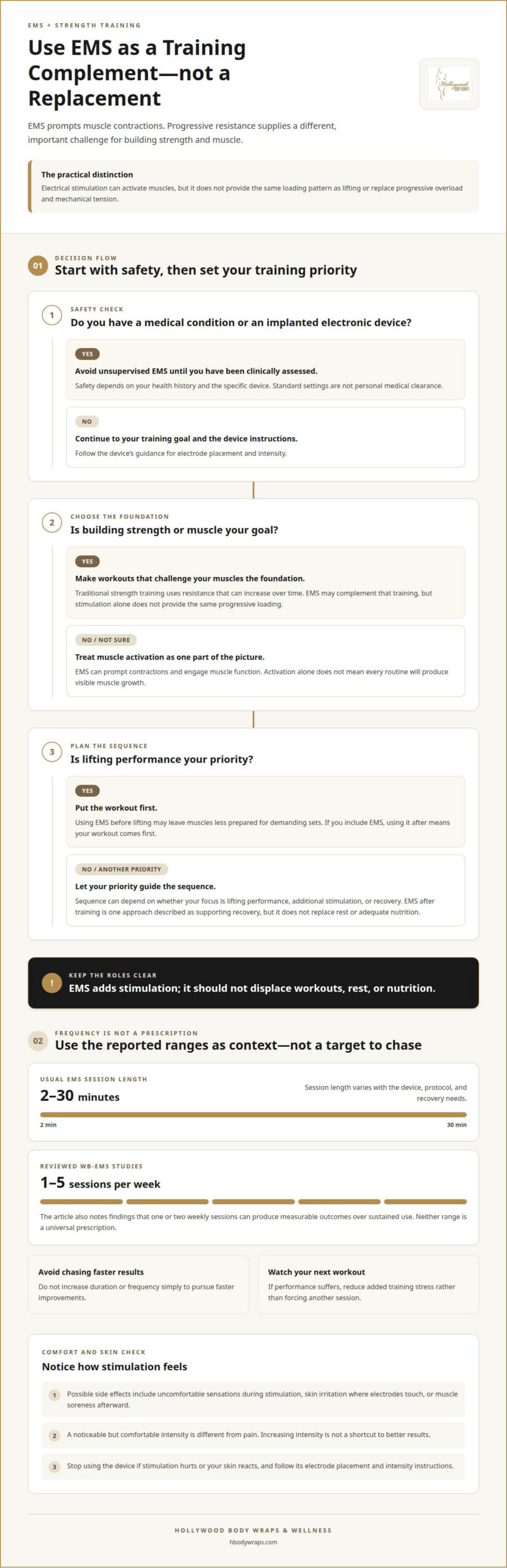
No. EMS can create muscle contractions, but it doesn’t replace exercise or the progressive resistance of traditional training. If you want to build strength and muscle, consider it a possible complement, not a substitute.
EMS and Conventional Strength Training
Traditional strength training challenges muscles with resistance that can increase over time; EMS prompts contractions through electrical impulses. That difference matters because progressive overload and mechanical tension are important parts of muscle growth. A device can stimulate muscle activity, but that alone doesn’t provide the same loading pattern as lifting. If strength is your goal, make workouts that challenge your muscles the foundation.
EMS as a Training Complement
EMS can complement workouts, but it shouldn’t displace them. Pairing it with resistance training preserves the progressive challenge needed for strength, while stimulation adds another way to activate muscles. Using EMS before lifting may leave muscles less prepared for demanding sets; using it after means your workout comes first. The right sequence depends on your priority, whether that’s lifting performance, additional stimulation, or recovery.
Training Sessions and Frequency
EMS session length and frequency vary with the device, protocol, and recovery needs. Usual session times range from 2 to 30 minutes, while reviewed WB-EMS studies used one to five sessions per week. Another finding indicates one or two weekly sessions can produce measurable outcomes over sustained use. These ranges aren’t a universal prescription. Avoid increasing duration or frequency simply to chase faster improvements.
Recovery and nutrition still matter. Muscles need time between demanding workouts, and nutrition supports adaptation. EMS after training is one approach described as supporting recovery, but it doesn’t replace rest or adequate nutrition. Pay attention to fatigue at your next workout. If your performance suffers, reduce added training stress rather than forcing another session.
People with medical conditions or implanted electronic devices should avoid unsupervised EMS until they have been clinically assessed. Safety depends on health history and the specific device, so standard settings are not personal medical clearance.
What is Electrical Muscle Stimulation (EMS)?
EMS uses electrical impulses to prompt muscle contractions, creating activation without the same movement pattern as a workout. Research suggests it can support strength and muscle growth, though results depend on how it is used.
Muscle Activation and Growth
Muscle activation describes a muscle contracting in response to stimulation, and repeated contractions may engage muscle function. EMS can activate fast-twitch Type II muscle fibres. A meta-analysis in the Journal of Strength and Conditioning Research reviewed 89 published trials on EMS and athletic performance. Those trials reported improvements in strength, power, and speed after 3 to 6 weeks of stimulation.
That evidence supports potential fitness benefits, not an automatic increase in muscle mass. For example, a study involving male badminton players reported improved muscle function of 10-15% after 5 to 6 weeks of treatment. Training design and consistent engagement still matter when interpreting outcomes. Muscle activation is one part of the process, not proof that every EMS routine produces visible muscle growth.
EMS, TENS, and NMES
EMS is a broad term for electrical stimulation that prompts muscle contractions; NMES specifically describes stimulation intended to activate nerves and muscles. TENS generally targets sensory nerves and is commonly used for pain relief rather than muscle training. The purpose matters: a device intended for sensory stimulation may not be designed for muscle activation or fitness training.
Possible side effects include uncomfortable sensations during stimulation, skin irritation where electrodes touch, or muscle soreness afterward. Stop using the device if stimulation hurts or your skin reacts, and follow its instructions for electrode placement and intensity.
If you’re exploring muscle-focused stimulation, the SculptX EMS muscle stimulator is a relevant option to learn about as you consider how EMS may fit your goals.
How electrical muscle stimulation produces contractions
An EMS device sends an electrical signal through electrodes placed over target muscles. The signal prompts the muscle to contract and then release, creating a repeated pattern. For example, stimulation over the quadriceps can produce contractions in the front of the thigh. The device controls the electrical output, while electrode placement determines which area receives stimulation.
Each pulse activates muscle tissue, producing rhythmic contractions that can act like a mechanical pump. The sensation may feel like tightening or pulsing beneath the electrodes. Intensity matters: a noticeable but comfortable setting is different from one that causes pain. Increasing intensity isn’t a shortcut to better results. The goal is controlled activation, not discomfort.
Electrode pads are placed over the muscle group the routine aims to engage. The quadriceps, glutes, and back are examples of major areas targeted with EMS. In a single-muscle routine, pads focus stimulation on that area; full-body EMS places electrodes across several regions. Follow the specific device’s placement instructions, since pad positions and configurations vary.
Coverage changes the experience. A full-body setup can stimulate several muscle groups during one session, while localized placement concentrates the signal on one region. For example, pads over the glutes and thighs target different areas from pads placed only over the arms. Proper contact helps deliver stimulation as intended; misplaced or poorly attached pads may cause uneven sensations rather than a clear contraction.
In a clinical setting, a routine may be tailored by adjusting placement and intensity to the person’s comfort and target muscles. The process is straightforward: position the electrodes, begin at a comfortable intensity, then adjust according to the contraction and sensation. A controlled signal should feel rhythmic, not sharp or painful. These details explain how EMS produces contractions, but contractions alone don’t show how much muscle growth a routine will produce.
Hypertrophy and progressive muscle adaptation
Hypertrophy means an increase in muscle size as tissue adapts to repeated training demands. EMS can contribute to that stimulus, but a contraction alone doesn’t determine how much growth follows. Muscle adaptation depends on repeated challenge, recovery, and the ability to progress a training program over time. A target muscle needs a reason to adapt, not just electrical activation.
A 2021 systematic review and meta-analysis by Kemmler and colleagues analyzed 16 controlled WB-EMS studies involving 897 non-athletic adults. In a 2021 review, Kemmler and colleagues reported an effect size of 1.23 SMD for muscle mass in WB-EMS studies. These findings support EMS as a potential muscle-building stimulus in studied programs. They don’t make every protocol equivalent, since frequency, intensity, and participant training status can differ.
Progressive adaptation means increasing the challenge as the body adjusts. In resistance training, that can mean gradually adding load or repetitions. EMS programs also need appropriate progression and recovery; repeating an unchanged stimulus may not keep challenging muscle tissue. Combining EMS with voluntary exercise can provide both prompted contractions and intentional movement, but EMS shouldn’t replace progressive loading in a strength program.
Study findings show why outcomes need context. After four weeks of EMS strength training, one controlled study reported a 17% increase in maximum strength, but ultrasound showed no visible hypertrophy. Another study reported a 27% strength increase and significant muscle-volume gain visible on ultrasound by the end of the eighth week. Strength gains and muscle-size changes are related, but they aren’t identical outcomes.
For a muscle-growth goal, consider EMS within a program that also includes progressive resistance, recovery, and nutritional support. To explore an EMS muscle stimulation option, review how it may fit alongside your existing training approach.
Hollywood Body Wraps & Wellness: SculptX EMS muscle stimulator
Hollywood Body Wraps & Wellness offers the SculptX EMS muscle stimulator for readers interested in adding muscle stimulation to their wellness routine. EMS may complement exercise, but it shouldn’t be treated as a replacement for progressive strength training when muscle growth is the goal. Understanding that distinction can help you decide whether stimulation fits your approach.
For a body-focused wellness option, Hollywood Body Wraps & Wellness offers the SculptX EMS muscle stimulator. It may be worth considering alongside your existing goals, while keeping clear that muscle stimulation is not a substitute for training.
Contact Hollywood Body Wraps & Wellness in Tampa to discuss the SculptX EMS muscle stimulator and your goals.
Choose a Next Step That Fits Your Goals
Whether EMS muscle stimulation builds muscle is only one part of deciding how to support your wellness goals. First, identify the outcome you want and how it fits with your current routine. Muscle-focused stimulation and appearance-focused services address different goals, so choose based on what you want to achieve.
Hollywood Body Wraps & Wellness offers the SculptX EMS muscle stimulator, Mineral inch loss Body Wraps, a Non invasive facial lift, and Facials. These services address different wellness and aesthetic interests; none is a substitute for strength training.
If you’d like to discuss whether EMS fits your goals, contact Hollywood Body Wraps & Wellness. Take the next step at a pace that feels right for you.
Frequently Asked Questions
Does EMS Build Muscle?
Whether EMS muscle stimulation builds muscle depends on the training program and the challenge muscles receive. EMS may support muscle growth, but it doesn’t guarantee gains. Consider what you’re measuring: strength, endurance, and muscle size are separate outcomes. Track the one that matches your goal.
Can EMS Replace Workouts?
No, EMS shouldn’t replace workouts if you want the broader benefits of exercise. A workout challenges muscles through intentional movement and resistance, while EMS adds electrical stimulation. For example, someone using EMS can still plan workouts that train movement patterns and build fitness. Treat stimulation as an additional tool, not a reason to skip exercise.
Can EMS replace lifting weights?
No. EMS isn’t a direct substitute for lifting weights when your aim is progressive strength training. Weight exercises let you adjust resistance and practise controlled movements, such as squats or presses. EMS may add stimulation, but it doesn’t reproduce the same training task. Keep resistance exercises in your routine if progressively challenging your muscles is a priority.
Can beginners use EMS?
Beginners can consider EMS as an addition to a fitness routine, not a replacement for learning basic movements. Follow the device’s instructions for electrode placement and intensity, and choose a setting that feels noticeable but comfortable. Pairing stimulation with familiar exercises, such as bodyweight squats, can help clarify its role in your routine.
How Often Should You Use EMS for Muscle Growth?
One or two EMS sessions per week can produce measurable outcomes with sustained use. Fit the frequency around your workouts and recovery rather than adding sessions automatically to every training day. For example, note whether your next strength session feels unusually tiring after stimulation. Adjusting the schedule to preserve workout quality helps keep EMS complementary to training.
How long does it take to see results from EMS training?
Consistent EMS use may bring noticeable changes in muscle tone, endurance, and strength within 4-6 weeks. Meaningful strength and lean-mass changes may take 12 to 16 weeks or longer. The timeline depends on what you’re tracking: feeling stronger, improving endurance, and gaining muscle mass are different outcomes. Use the same measure over time to assess progress.