
Cavitation for cellulite on thighs may contour localized fat, but it has limited effect on the bands that cause cellulite dimpling. It may slightly smooth the skin, so it’s better understood as a body-contouring option than a standalone cellulite or weight-loss treatment. It’s generally suited to targeted areas when the skinfold is at least 2 cm, but isn’t recommended during pregnancy or breastfeeding, or with metal implants or a pacemaker.
Want smoother-looking thighs without surgery? Cavitation may seem like an option, but it targets localized fat, not every factor behind cellulite’s dimpled texture. Radiofrequency (RF), by contrast, may support skin tightening. The right approach depends on the change you want.
Here, you’ll learn how cavitation may affect thigh cellulite, who may be a candidate, and how it compares with RF. You’ll also find out what results and upkeep can realistically involve, so you can approach treatment with clear expectations.
Key Takeaways
- Separate concerns about localized fat from cellulite dimpling to set a more realistic treatment goal.
- Use skinfold depth and personal health factors to understand whether ultrasonic cavitation may be suitable.
- Compare cavitation with radiofrequency by the concern each approach is intended to address.
- Plan for gradual changes and ongoing habits rather than expecting one session to deliver lasting cellulite removal.
- Explore non-invasive cellulite treatment or Mineral inch loss Body Wraps when considering support for your body-contouring goals.
Who is a good candidate for ultrasonic cavitation?
Ultrasonic cavitation is intended for localized fat deposits, such as a specific area of fullness on the thighs. It isn’t a direct fix for every cause of cellulite. The treatment applies ultrasound energy to tissue beneath the skin, with the aim of disrupting fat cells in the selected area. A change in localized fullness is different from releasing the connective bands associated with dimpling.
During treatment, a practitioner moves an ultrasound applicator over the selected area. Sound waves create pressure changes in tissue, described as forming and collapsing tiny bubbles around fat cells. This cavitation effect may disrupt fat-cell membranes. Ultrasound is described as reaching depths from 1-2 mm to as much as 25 mm, depending on the device and approach. Those depths don’t promise a particular result.
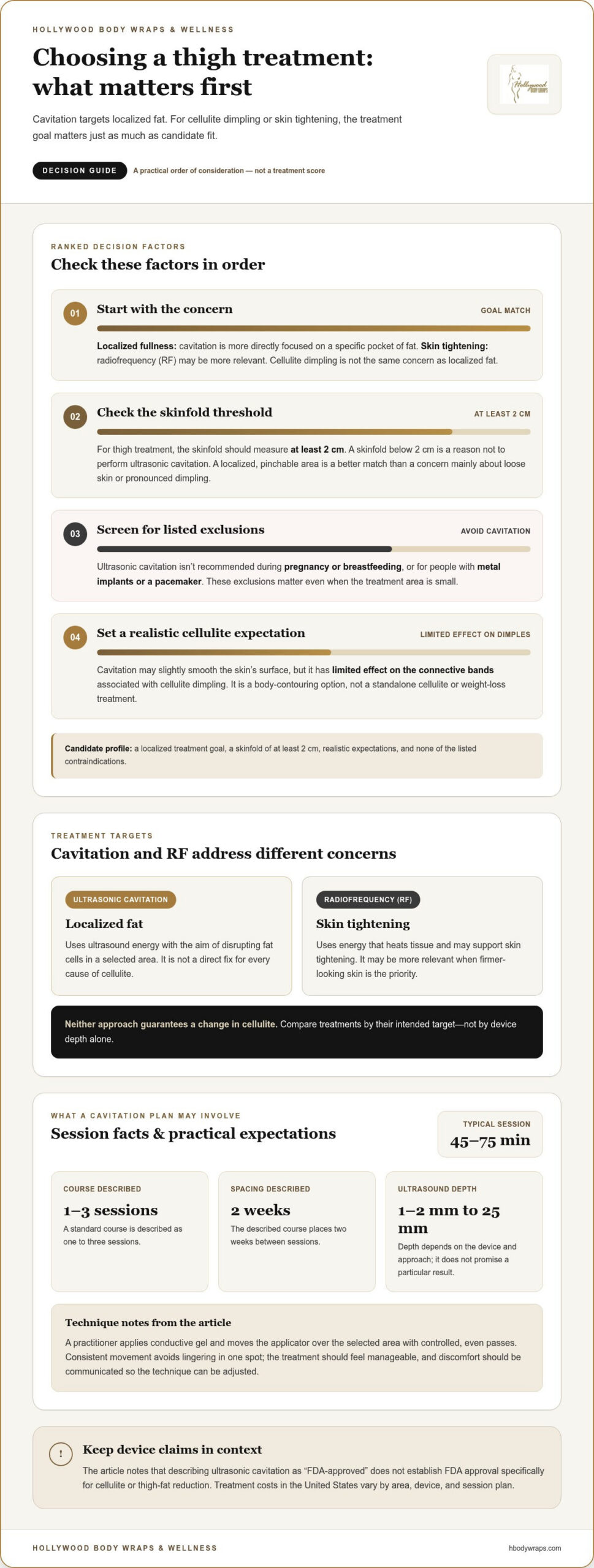
For thigh treatment, the target is usually a localized pocket rather than general weight loss. A skinfold below 2 cm is a reason not to perform ultrasonic cavitation. Someone with a thicker, pinchable area may be a more suitable candidate than someone whose concern is mainly loose skin or pronounced dimpling. For someone considering cavitation for cellulite on thighs, the key is distinguishing localized fullness from skin texture.
Different treatments have different aims. Radiofrequency (RF) uses energy that heats tissue and may support skin tightening, while cavitation targets localized fat. Laser treatments use light energy, and acoustic wave therapy uses sound waves to address skin texture. Subcision releases fibrous bands beneath dimples. These methods aren’t interchangeable.
For cellulite, cavitation may slightly smooth the skin’s surface, but it has limited effect on the bands that contribute to dimpling. If your main goal is firmer-looking skin, RF may be more relevant. If you want to target a localized fat pocket, cavitation is more directly focused on that concern. Neither guarantees a change in cellulite.
Ultrasonic cavitation is sometimes described as FDA-approved, but that wording does not establish FDA approval specifically for cellulite or thigh-fat reduction. Treatment cost in the United States varies by area, device, and session plan. Hollywood Body Wraps & Wellness provides current pricing through its Book Now option.
Suitability also depends on health circumstances. Ultrasonic cavitation isn’t recommended during pregnancy or breastfeeding, or for people with metal implants or pacemakers. Those exclusions matter even when the treatment area is small. A skinfold of at least 2 cm, a localized goal, and the absence of these listed factors help define a more appropriate candidate profile. These criteria can clarify whether cavitation for cellulite on thighs aligns with your concern.
What is better for cellulite, RF or cavitation?
The better fit depends on whether you’re most concerned about skin texture or a localized fat deposit. RF uses energy that heats tissue and may support skin tightening; ultrasonic cavitation targets localized fat. Someone focused on thigh dimpling has a different goal from someone targeting a distinct pocket of fullness. Neither approach addresses every contributor to cellulite.
A cavitation session typically lasts 45 to 75 minutes. A standard course is described as one to three sessions, with two weeks between sessions. Those figures help you picture the appointment plan, but they don’t mean every person or treatment area follows an identical schedule. The area treated and the approach used shape how the session is organized.
Technique matters during treatment. A practitioner applies conductive gel, then moves the applicator across the selected area with controlled, even passes. The gel helps the device maintain contact with the skin, while consistent movement avoids lingering in one spot. For a thigh treatment, the practitioner works across the selected area rather than focusing repeatedly on a single dimple.
Sensation can vary during treatment. Follow the practitioner’s directions and speak up if anything feels uncomfortable, so the technique can be adjusted. Treatment should feel manageable, not like a test of endurance. Matching the method to your goal matters too: cavitation targets localized fat, while RF may be more relevant when skin tightening is the priority.
Radiofrequency equipment may reach a depth of 25 mm, while the depth and effect of ultrasound depend on the device and application. More energy or deeper reach doesn’t automatically mean better cellulite results. Compare the intended target, session plan, and comfort level instead of choosing by a device specification alone.
Other approaches serve different goals. Lipo laser is another non-invasive fat-reduction option, while exercise supports broader body-composition goals but doesn’t directly release the fibrous bands beneath cellulite dimples. Compare treatments by first identifying what you want to change, then considering how each method works and whether maintenance may be involved.
If your priority is a dedicated approach to visible cellulite, explore a non-invasive cellulite treatment as another option. The useful next step is matching the treatment focus to your goal, whether that’s skin texture, tightening, or localized fullness.
Candidate suitability and contraindications
A suitable candidate has a localized area to target, realistic expectations, and no listed contraindication. Ultrasonic cavitation is a body-contouring method, not a weight-loss treatment or an invasive procedure. The skinfold should measure at least 2 cm; treatment isn’t recommended below that threshold. Pregnancy, breastfeeding, metal implants, and pacemakers are also reasons to avoid this method.
For cavitation, follow the treatment provider’s preparation and aftercare instructions. General recommendations sometimes include avoiding food or drink for at least one hour beforehand, drinking a full glass of water afterward, and gently massaging the treated area for one to two minutes. These steps don’t replace screening or determine eligibility.
Share relevant health details during a consultation, especially pregnancy or breastfeeding status and any metal implants or pacemaker. These factors matter because they can make ultrasonic cavitation unsuitable, even when the target area is small. Skinfold thickness matters too: a person with a measurement under 2 cm falls below the stated treatment threshold. A desire to lose weight overall is not, by itself, a suitable reason to choose localized cavitation.
Keep the treatment area and its limits in mind. Cavitation targets localized fat; it doesn’t address every cause of thigh dimpling or replace broader weight management. Drinking water supports normal hydration, but it is not proof that treatment will remove cellulite or produce a particular contour. Set a specific goal, such as addressing localized fullness, rather than expecting a major change in weight.
Temporary redness, thirst, or nausea are described as possible mild effects that usually fade within a few hours. Ultrasonic cavitation is also described as requiring no downtime, but that doesn’t make screening or aftercare unimportant. Don’t skip screening or disregard discomfort simply because recovery time is not expected.
Pregnancy and lactation are clear exclusions in the listed guidance, as are metal implants and pacemakers. A person who falls into one of these groups should not proceed with cavitation. For others, the key suitability checks are a skinfold of at least 2 cm, a localized treatment goal, and an understanding that contouring is different from weight loss. These criteria help distinguish a potentially appropriate treatment from an unsuitable one without overstating what the method can do.
Cavitation results and maintenance
Ultrasonic cavitation may change localized contour, but cellulite reduction and skin tightening are separate goals. Results depend on the treatment course and the concern being targeted.
Realistic Results and Timing
Results describe visible changes in contour or skin appearance after treatment, not guaranteed cellulite removal. Some clients may see a circumference reduction of 1 to 5 cm after one session, but that measurement doesn’t establish lasting smoothing. Texture changes may take longer: smoother-looking skin may begin to appear after four to six weeks of consistent use, while cavitation results may take 6 to 12 weeks to show. That timeline helps set expectations and avoid judging the outcome immediately.
For thigh cellulite, the distinction is important. Cavitation targets localized fat, and its effect on the bands behind dimpling is limited. A change in circumference may therefore occur without a comparable change in cellulite appearance. One, two, or three sessions don’t provide long-term cellulite removal or skin tightening; some people may need up to 12 treatments to see significant changes. Final results may take up to three months after the last treatment.
How Long Results Last
Cavitation results may persist, but there is no fixed duration that applies to everyone. Fat cells affected by ultrasonic cavitation are described as not growing back, but that doesn’t mean thigh cellulite cannot return or the area’s appearance will stay unchanged. Cellulite has contributors beyond localized fat, so contour and surface texture may change differently over time. Plan maintenance around your specific goal.
A balanced diet and regular exercise are recommended to support healthy weight management after treatment. These habits can support body composition, but they don’t guarantee cellulite won’t become visible again. If smoother-looking skin is your main goal, assess texture separately from circumference rather than relying on one measurement.
Think in terms of gradual progress. Take consistent measurements or photos under similar conditions, and compare them across the 6-to-12-week window rather than relying on a single immediate check. Changes in lighting, posture, and how the tape sits can affect comparisons. A clear record helps distinguish a real shift in appearance from ordinary variation.
Maintenance means sustaining habits that support your chosen outcome, not automatically repeating a procedure. Keep exercise and balanced eating consistent, and assess whether your priority is contour, skin firmness, or dimpling. Tracking the specific goal over time helps keep expectations grounded.
Cavitation and cellulite reduction
Think of ultrasonic cavitation as localized body contouring, not a complete cellulite-removal method. Its sound waves are intended to disrupt fat cells in a selected area, while cellulite dimpling also involves connective bands beneath the skin. That’s why a contour change and smoother-looking skin are separate outcomes, even when both concern the thighs.
The treatment’s effect on cellulite is limited because ultrasound doesn’t release the fibrous bands that pull skin inward. A small change in the fat layer can alter the area’s outline without removing those visible depressions. External cavitation devices are described as causing less than 1°C of temperature change, so they don’t work like a heat-based skin-tightening treatment. Keep the target specific: localized fullness, not complete cellulite reduction.
Frequency also matters to the treatment method. The spa’s ultrasound approach is described as using low-frequency sound at 40 kHz. The intended action is on fat cells, not direct mechanical release of cellulite bands. By contrast, radiofrequency uses heat and is associated with skin tightening; collagen-related goals therefore call for a different treatment discussion. These technologies address different tissue concerns rather than offering interchangeable routes to the same result.
What does that mean for a realistic goal? A course of cavitation may produce up to 10 cm of reduction, according to the treatment description, but that measurement refers to contour, not a guaranteed change in thigh dimples. Fat cells disrupted by cavitation are described as not growing back. Still, cellulite appearance can change because its structure involves more than fat alone. A circumference reading cannot prove that collagen, skin firmness, or underlying bands have changed.
Ultrasonic cavitation is described as involving no downtime, but that convenience doesn’t make it a standalone weight-loss approach or a reliable way to release cellulite bands. If dimpling is your main concern, match your goal to the method: fat-cell disruption targets localized fullness, skin tightening targets firmness, and band release addresses the structures that create depressions.
Choose by the result you want to see in the mirror, not by the word “cavitation” alone. For a focused approach to visible dimpling, explore non-invasive cellulite treatment; for laxity, consider whether skin tightening better matches the concern. This distinction helps set a clear goal before treatment begins, and keeps a change in contour from being mistaken for complete cellulite removal.
Hollywood Body Wraps & Wellness: Mineral inch loss Body Wraps
Hollywood Body Wraps & Wellness offers Advanced body wraps and Non-invasive body sculpting for clients focused on contouring, as well as Non-invasive Cellulite Treatment for those concerned about the appearance of cellulite. These services address different goals. The spa serves clients in Tampa and nearby Carrollwood, Lutz, Wesley Chapel, and Westchase.
If you’re comparing non-invasive treatments, start by defining your priority: localized fullness, cellulite appearance, or skin firmness. Hollywood Body Wraps & Wellness can help you consider its available body sculpting and cellulite treatment options in light of that goal. No single method should be expected to address every concern.
Contact Hollywood Body Wraps & Wellness or visit hbodywraps.com to explore your options.
Choose a next step that fits your goals
To decide whether cavitation for cellulite on thighs suits your goals, first clarify the change you want: a different contour, smoother-looking skin, or support for both concerns. Keep that priority in mind when discussing treatment options, so you can compare what each approach is designed to address and set realistic expectations.
Hollywood Body Wraps & Wellness offers Non-invasive Cellulite Treatment and Advanced body wraps for body-focused goals, as well as Facial Treatments and a Non-invasive facial lift for facial care. The spa serves Tampa and nearby Carrollwood, Lutz, Wesley Chapel, and Westchase. Choose based on your priority, not the service name alone.
For a welcoming next step, contact Hollywood Body Wraps & Wellness to discuss your goals and explore an approach that feels right for you. Your wellness journey can begin with one considered choice.
Frequently Asked Questions
How Does it Work?
Ultrasonic cavitation uses sound waves from an applicator moved across a selected body area. The pressure changes are described as forming and collapsing tiny bubbles around fat cells, disrupting their membranes. The body processes the affected material over time. A thigh treatment targets a localized area rather than changing overall body weight, so it is intended for contouring, not complete cellulite removal.
Does it destroy fat cells?
Ultrasonic cavitation is described as disrupting fat cells in the treated area, and those affected cells are described as not growing back. That doesn’t mean the surrounding area can never change: body contour and cellulite appearance involve more than the treated cells. Weight changes can affect thigh shape, while connective bands beneath the skin can continue to contribute to dimpling.
How long do results last?
There is no single fixed duration that applies to everyone. Disrupted fat cells are described as not growing back, but the appearance of the thighs can still change with weight fluctuations and other factors affecting skin texture. To assess progress, compare measurements or photos taken under similar conditions over time. Track circumference and cellulite dimpling separately because they are different outcomes.
So what is better between the two: RF or cavitation?
RF may be more relevant when skin tightening is the goal, while cavitation targets localized fat. Choose based on your main concern rather than assuming one method treats every aspect of cellulite. Someone focused on a distinct pocket of fullness may consider cavitation; someone prioritizing skin firmness may look at RF. Cellulite dimpling involves connective bands, so neither approach should be treated as a direct substitute for band release.
What is ultrasonic cavitation for thigh cellulite, and how does it work?
Ultrasonic cavitation is a non-invasive contouring treatment that applies ultrasound energy to a selected thigh area. The sound waves are described as disrupting fat cells, which may affect localized fullness. The treatment has limited effect on the connective bands associated with cellulite dimples, so a contour change doesn’t necessarily mean smoother-looking skin. It is most relevant when the goal is a targeted fat deposit, not overall weight loss.
How many cavitation sessions are usually needed for thighs, and how often are they done?
A standard course is described as one to three sessions, with two weeks between sessions. Some people may need up to 12 treatments to see significant changes, so the standard course isn’t a promise of a particular outcome. The area treated and the goal matter when considering a schedule. For example, contour changes and cellulite texture should be assessed separately when deciding whether progress matches your aim.
What are the risks, side effects, and contraindications of cavitation treatment?
Temporary redness, excessive thirst, or nausea are described as possible mild effects that usually fade within a few hours. Ultrasonic cavitation isn’t recommended during pregnancy or breastfeeding, or for people with metal implants or pacemakers. A skinfold below 2 cm is also outside the stated treatment threshold. Before a session, share these relevant circumstances and discuss any discomfort during treatment rather than ignoring it.