
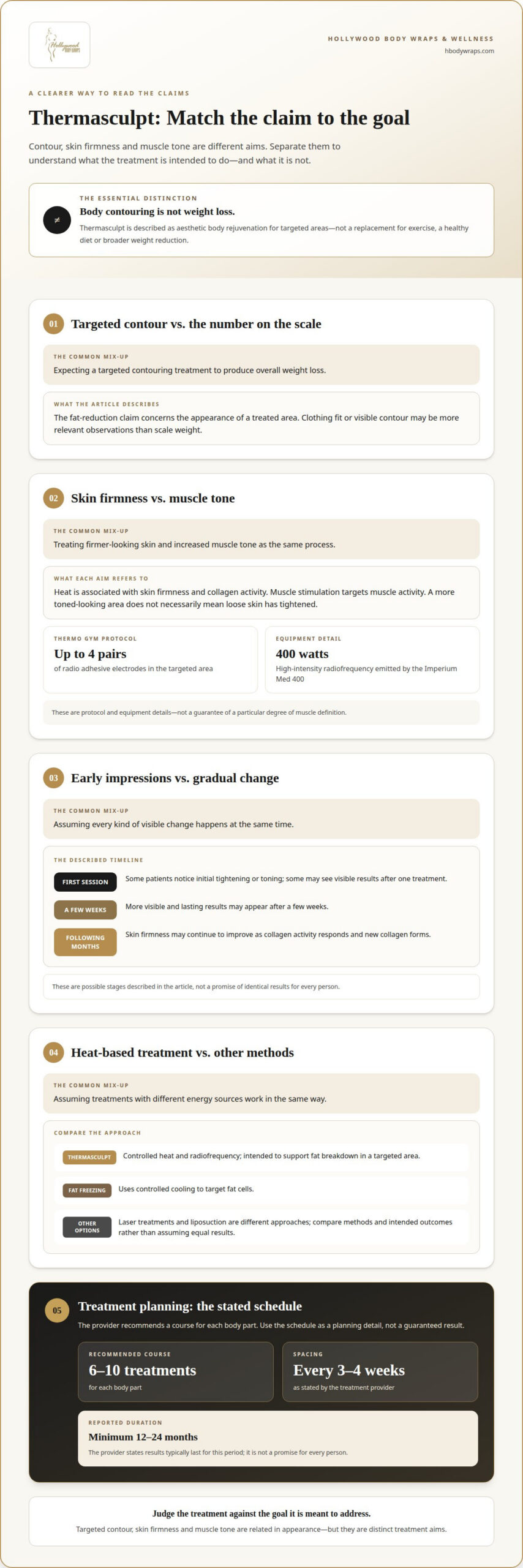
Thermasculpt is intended to address specific contouring goals: controlled heat and radiofrequency are described as supporting fat breakdown, while muscle stimulation focuses on muscle tone. Heat is also intended to encourage collagen activity and improve the firmness and appearance of treated skin. To understand whether Thermasculpt really works, separate these aesthetic aims from weight loss: it is a body-contouring treatment, not a weight-loss solution.
It’s reasonable to want more than a polished promise. You want to understand what a treatment is intended to do, how it works, and what kind of change to expect. Skin firmness, fat reduction, and muscle toning involve distinct processes, and visible changes may develop on different timelines.
This guide explains how controlled heat and radiofrequency are described to affect treated areas, where muscle stimulation fits, and how collagen activity relates to skin tightening. You’ll also learn what Thermasculpt is and isn’t intended to achieve, so you can assess whether its approach fits your goals.
Key Takeaways
- Skin firmness may continue to improve over the following months as collagen activity responds to treatment.
- Initial tightening or toning may appear after a first session, while more visible results can take a few weeks.
- Radiofrequency and controlled heat work differently from fat freezing, and muscle stimulation has its own role in toning.
- Think of the treatment as aesthetic body rejuvenation, not a weight-loss solution or replacement for exercise and a healthy diet.
Potential skin tightening and collagen activity
Thermasculpt uses heat intended to encourage collagen activity in treated skin. Collagen helps support the skin’s structure and firmness. The treatment’s effects may continue improving over the next few months as new collagen forms. Some patients notice initial tightening and toning after their first session. That early change and later collagen response are different stages, not identical results. For example, a first-session impression may precede gradual changes in skin texture. The treatment is non-invasive, and daily activities can resume immediately afterward, with no downtime described.
Skin laxity refers to looseness, while muscle tone is a separate concern. Thermasculpt’s heat is associated with skin firmness; muscle stimulation targets muscle activity. These aims can overlap visually, but they are not the same process. A more toned-looking area does not necessarily mean looser skin has tightened. Ask which treatment goal matters most: firmer-looking skin, muscle tone, or both. That distinction helps make treatment planning more specific. The treatment provider recommends a course of 6-10 treatments for each body part, scheduled once every 3-4 weeks.
How does Thermasculpt compare with CoolSculpting, laser treatments, and liposuction? Thermasculpt is described as using controlled heat and radiofrequency, while CoolSculpting uses controlled cooling. Laser treatments and liposuction are different approaches, so compare their methods and intended outcomes rather than assuming they produce equal results. No single option suits every aesthetic goal.
Are Thermasculpt providers FDA-cleared, and how can patients verify a clinic’s credentials? FDA status applies to a specific device and its intended use, not to a clinic as a whole. Identify the exact device and check FDA records, then verify practitioner credentials with the organization that issued them. Keep these checks separate when evaluating treatment information.
How long do Thermasculpt results last? The provider states results typically last for a minimum of 12-24 months. That timeframe describes reported treatment results, not a promise for every person. For skin laxity, consider the treatment goal, the treated area, and the gradual collagen timeline together. Those details help set a realistic frame for judging changes after a course.
Fat reduction and muscle toning claims
ThermoSculpt is described as aesthetic body rejuvenation, not a weight-loss treatment. Its fat-reduction claim concerns targeted contouring, not overall weight change. Some patients see visible results after one treatment, while more visible and lasting results may appear after a few weeks. Those timeframes describe possible changes, not a scale-based measure. For example, clothing fit reflects a different goal from body weight. Does Thermasculpt really work for targeted fat reduction? Its described purpose is contouring, so assess the treated area rather than expecting overall weight loss.
Separate your goals before judging results. If your priority is a more defined area, consider whether a contouring treatment suits that aim. If your goal is broader weight reduction, Thermasculpt is not presented as a substitute for that process. It also does not replace exercise or a healthy diet. Track one consistent observation, such as how a specific garment fits, and compare it over time. This gives you a practical way to assess progress without relying only on the scale.
Muscle tone is a distinct part of the discussion. ThermoSculpt’s Thermo gym protocol can use up to 4 pairs of radio adhesive electrodes in the targeted area. The Imperium Med 400 used for ThermoSculpt emits high-intensity radiofrequency at 400 watts. These details describe equipment and protocol, not a guaranteed degree of muscle definition. To judge whether Thermasculpt really works for your goals, first clarify whether you’re seeking contour, muscle stimulation, or both.
For muscle-focused support, SculptX EMS muscle stimulation is another option to explore. Distinguish a muscle-toning goal from ThermoSculpt’s aesthetic contouring claims rather than treating them as interchangeable. Before a session, note the area and your main goal. Afterward, use the same observation method, such as garment fit or visible contour, to compare changes consistently. For an overview of muscle-toning treatment options, explore approaches focused specifically on muscle stimulation.
How radiofrequency and controlled heat are described as working
Thermasculpt is described as a non-invasive treatment using radiofrequency energy and controlled heat. The intended effect is support for fat breakdown in the targeted area. The sequence is straightforward: energy delivers heat to the treatment area, and the treatment aims to influence its appearance. That description explains the approach, not the amount of change a person will see. It also helps clarify why the technology should not be judged by weight alone. Targeted contouring and overall body weight are different measures.
Compare the energy source, not just the treatment names. Thermasculpt uses controlled heat and radiofrequency; fat freezing uses controlled cooling to target fat cells. These are distinct approaches, not two names for the same process. When comparing them, identify whether your goal involves a heat-based treatment or cooling-based fat targeting. Laser treatments and surgical procedures use other approaches. Comparing intended goals and techniques gives you a clearer basis for understanding what each method claims to address.
What are the side effects, risks, and contraindications of Thermasculpt? The treatment is described as non-invasive, and the spa describes its services as offering zero downtime, no anesthesia, no scars. That description is not a complete side-effect or contraindication profile. Risk screening depends on the device instructions and a person’s health history.
Controlled heat describes how energy is applied; it does not prove a particular result. Keep the treatment claim separate from the outcome. Consider what area the protocol targets, what change it aims to support, and how progress will be assessed. A contour-focused goal, for example, differs from a goal based on overall weight. These distinctions make treatment information easier to interpret and prevent a technical term like radiofrequency from being mistaken for a guarantee. The stated mechanism is one part of evaluating Thermasculpt; the goal and the way results are measured matter too.
Radiofrequency and muscle stimulation
Does Thermasculpt really work for your goal? The useful answer depends on the outcome you want to assess. Skin appearance, localized contour, and muscle firmness are different categories. Before a session, write down one priority and describe it plainly, such as wanting more definition in a specific area. A clear endpoint makes the treatment conversation more focused than a general request to “tone up.”
Create a simple progress note with three details: the area, your intended change, and what would count as a meaningful observation. For example, decide whether you’re focused on firmness or muscle definition before treatment. Keep those goals separate in your notes. Otherwise, a change in one area could be mistaken for progress toward another outcome. A clear record also makes it easier to discuss your observations later.
If a plan involves radiofrequency and muscle stimulation, ask which component is intended to address each goal and how those aims will be evaluated. The distinction matters: a device’s technology describes how treatment is delivered, while your goal describes the change you hope to observe. Keep those ideas connected, but don’t treat them as interchangeable.
Choose an assessment method that matches your priority. For a muscle-definition goal, focus your notes on that specific change rather than general body weight. For skin firmness, record that concern separately. This makes progress discussions more precise and helps prevent one measure from standing in for another. If you’re considering a muscle-focused approach, explore muscle-toning treatment options as part of deciding which direction aligns with your goal.
Hollywood Body Wraps & Wellness: Mineral inch loss Body Wraps
Hollywood Body Wraps & Wellness offers Mineral inch loss Body Wraps as a separate service for people exploring body-contouring options. If your goal is to consider a wrap rather than radiofrequency or muscle stimulation, this service may be relevant. A body wrap and a body-sculpting treatment have distinct purposes, so view the wrap as its own option, not as a way to guarantee or enhance Thermasculpt results.
Start by identifying the area and the outcome you want to discuss. That helps you decide whether a body wrap aligns with your interest, or whether another aesthetic service better fits your focus. For a calm, informative next step, contact Hollywood Body Wraps & Wellness to learn about Mineral inch loss Body Wraps.
Choose the next step that fits your goal
Your next step is to define the change you want, then match it to an approach designed for that concern. If you’re considering whether Thermasculpt really works for your goals, focus on the outcome you value most, such as skin appearance, contour, or muscle tone. A clear priority can make a treatment conversation more useful and help you compare options without expecting different services to do the same thing.
For other aesthetic goals, Hollywood Body Wraps & Wellness offers Mineral inch loss Body Wraps, a Non invasive facial lift, and Facials. Each offers a different focus, so choose based on the area and result you want to address. Contact Hollywood Body Wraps & Wellness to discuss a suitable next step. A thoughtful choice can help you move forward with clarity and confidence.
Frequently Asked Questions
How Does ThermaSculpt Work?
Thermasculpt is described as combining radiofrequency energy and controlled heat to support targeted body contouring. Its treatment aims may include fat reduction, skin firmness, and muscle toning, but these are distinct goals. Before treatment, identify which outcome matters most. For example, someone focused on muscle tone should distinguish that aim from a goal centered on skin appearance or localized contour.
How many sessions are needed and how long will it take?
The recommended course is 6-10 treatments for each body part, with sessions scheduled once every 3-4 weeks. That makes the treatment schedule a multi-session process, not a single appointment. To plan practically, identify the area you want treated and map the recommended spacing across your calendar. Some patients notice initial tightening and toning after their first session, while more visible results may appear after a few weeks.
What is ThermaSculpt Fat Reduction Treatment?
Thermasculpt is described as an aesthetic body-contouring treatment that uses radiofrequency and controlled heat to support targeted fat breakdown. It is not described as a weight-loss treatment. Someone hoping to change overall body weight should not treat a contouring procedure as a substitute for weight-management habits. The distinction is between targeting the appearance of a specific area and pursuing broader weight reduction.
Any advice I need to follow during the treatment?
Keep your treatment goal clear and follow the instructions provided for your session. The protocol is intended for a targeted area, so know which area is being addressed before starting. The spa describes its services as offering zero downtime, no anesthesia, no scars. To assess changes consistently, note your starting concern and use the same observation method later, such as checking the fit of the same garment.
Can it replace exercise?
No. Thermasculpt is not a substitute for exercise or a healthy diet. Treat it as an aesthetic service, not a replacement for habits that support general fitness and wellbeing. If your goal includes both body contouring and improved fitness, keep those aims separate when assessing progress. A treatment’s intended effect on a targeted area does not make regular movement or balanced eating unnecessary.
How can I judge if I was a candidate or not?
Start by matching your goal to the treatment’s intended purpose. A targeted contouring or skin-firmness goal differs from a plan focused on overall weight loss or exercise performance. Write down the area you want to address and the change you hope to assess. For people considering treatment in Tampa, this clear starting point helps make a conversation about options more focused and useful.